

Most privacy teams in mid-sized organisations are small, often one DPO, sometimes a handful of people. The knowledge they need lives elsewhere, in marketing, HR, customer service and IT. So the real test of a privacy platform isn’t how much it can record. It’s whether the people who hold the knowledge will keep it current and whether anyone can make sense of it when it matters.
That’s where these three qualities come in.
01 · SIMPLE
If it takes training to start, it won’t get started
Every extra required field is a reason for a busy colleague to put a task off until next week. Simplicity isn’t about doing less. It’s about asking for the minimum up front and letting the detail follow.
- Start with three fields. An assessment needs a name, a business unit and a template. Respondents, approvers, linked activities and risks can be added now or later.
- Work in your own order. Link processing activities and third parties before an assessment, during it, or after. The platform follows your operating model.
- Bring what you already have. Import an existing RoPA spreadsheet, a typical first import of 20 to 60 activities takes under an hour.
- Add as you go. Quick Add creates a missing vendor or activity without leaving the screen you’re on.
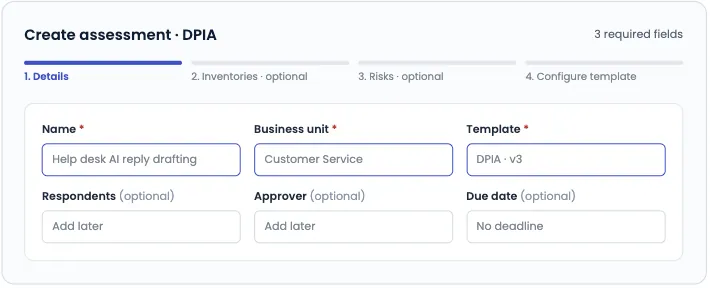
Three required fields to start. Everything else can be added now or later, in whatever order suits your team.
02 · VISUAL
A record you can see is a record you can use
Spreadsheets are good at storing a RoPA and poor at explaining one. The questions that matter, such as what depends on this vendor, where the gaps are, or when was this last reviewed, are questions about relationships. Relationships are easier to see than to read.
- One estate, several lenses. Full estate, Completeness, Review status and Blast radius views all draw on the same records.
- Filters that keep context. Narrow by business unit, vendor, risk or AI capability and matching activities keep all their linkages.
- Answers, not exports. An incident brief or a completeness picture is a click away, not a weekend in Excel.
- A dashboard on every module. Assessments, DSRs, incidents and risks each show status, SLAs and ownership at a glance, ready for when leadership asks.
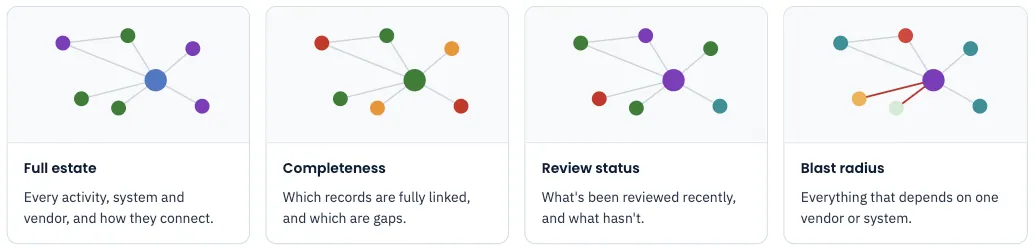
One estate, four ways to read it. Switch views without rebuilding a report.
Visual matters just as much when the question comes from upstairs. When the board or the leadership team asks how the privacy programme is doing, the answer shouldn’t take a week of spreadsheet archaeology. Every module, from assessments to data subject requests, incidents and risks, has its own dashboard showing what’s open, what’s overdue, what’s waiting for sign-off and where the work sits.
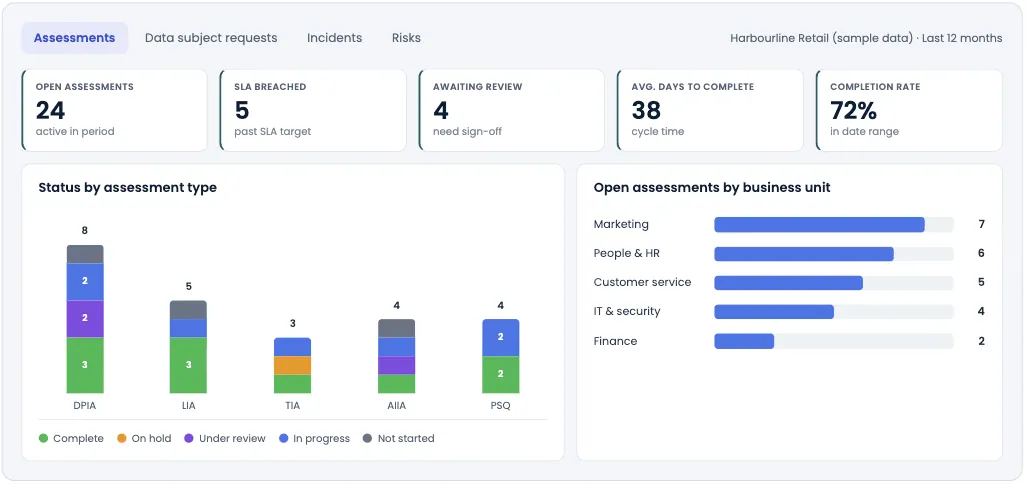
Sample data for a fictional company. Each module has its own dashboard, so “where are we?” has an answer on screen.
We’ve shown each of these in action this month: scoping a breach, finding the gaps in a RoPA and spotting where AI has arrived.
03 · FEDERATED
Privacy owned across the business, coordinated by you
No DPO can personally keep every record accurate. The people closest to the processing should maintain it. The privacy team should set the standard, check the work and spot the risk. Federation makes that the default rather than a heroic effort.
- Business units own their records. Every assessment belongs to a business unit, with a BU owner, respondents and an approver.
- Everyone sees what’s theirs. Template sections can be shown only to the roles they’re meant for, platform admin, privacy team, BU owner, approver or respondent.
- Nudges, not chasing. Set a due date and reminders are scheduled automatically.
- Easy to bring people in. Single sign-on for colleagues and the option to share an assessment with someone better placed to answer.
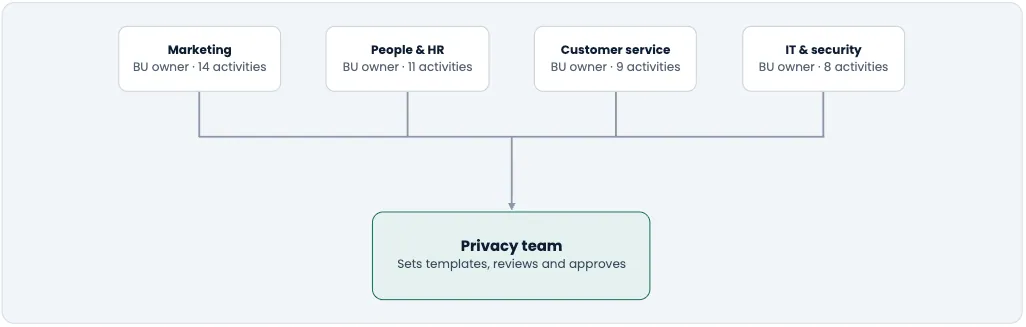
Illustrative. Business units keep their own records current; the privacy team sets the standard and signs off.
Why the three need each other
Each quality on its own only gets you part of the way. A simple tool that only the privacy team uses stays small. A federated programme without visibility becomes a pile of answers nobody can join up. And a beautiful map of stale data is still stale.
Simple gets people contributing. Federated keeps them contributing. Visual shows what it all adds up to.